

It’s an astonishing story: in less than five years, a small South American country shifted their energy production to run on renewable energy – and it was all driven by a little-known scientist with a crazy vision.
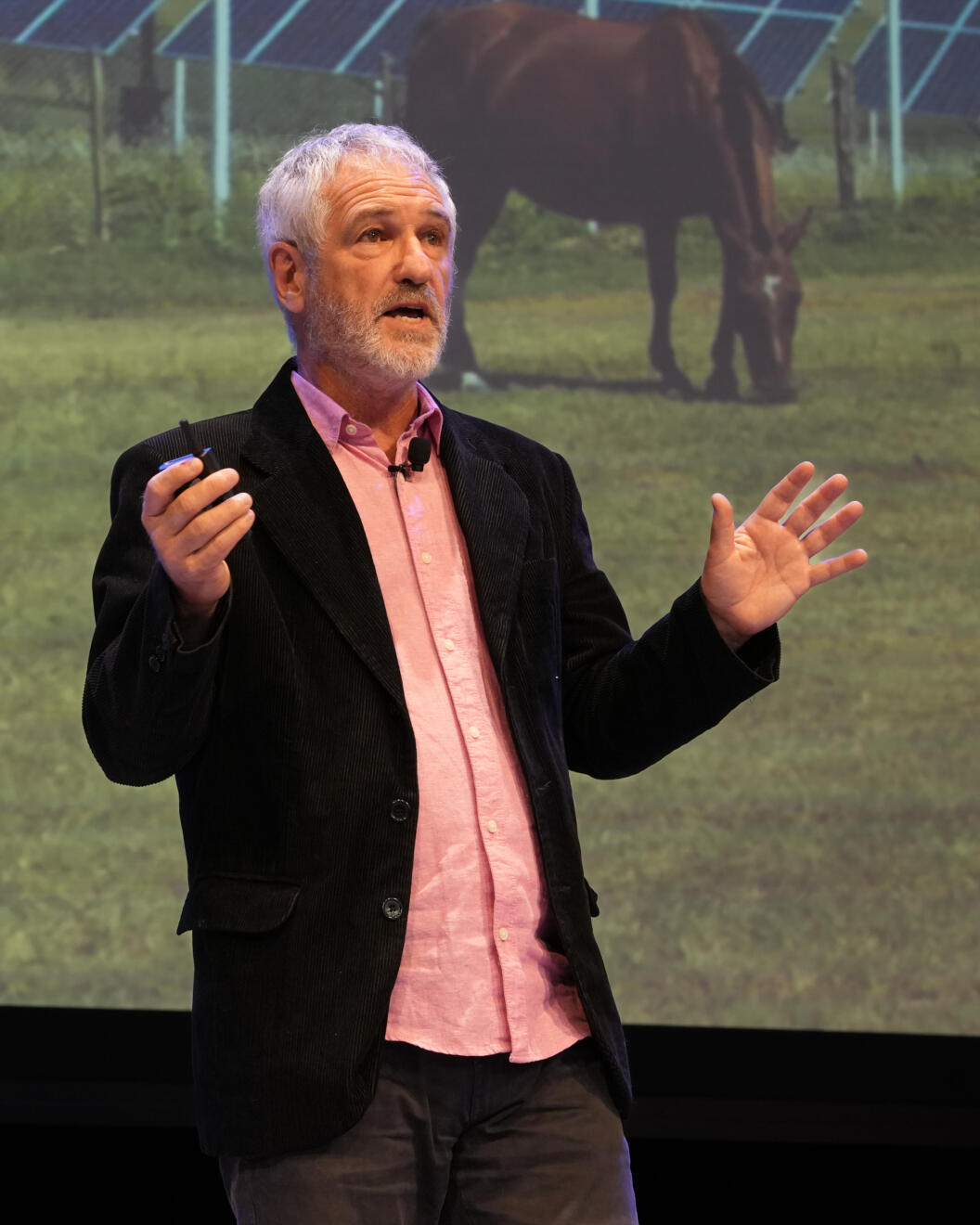
At the 2025 Mountain Towns 2030 Summit in Breckenridge, Colorado, Dr. Ramón Méndez Galain—Uruguay’s former Secretary of Energy and architect of one of the most ambitious energy transitions in the world—delivered a keynote that was equal parts masterclass, memoir, and manifesto. Framed as a five-act play, his story of leading Uruguay to 99% renewable electricity was a deep dive into policy, innovation, and political courage.
Act I: The Spark of a Crazy Idea
Méndez’s journey began with a formative moment from his youth in Paris. As a 20-year-old science student, he stumbled across a quote in a flea market: “He who lives without craziness is not as wise as he seems.” The phrase, displayed in every home he’d lived in since, would come to symbolize the improbable path he later followed from particle physicist to energy revolutionary.
Act II: Crisis and the Call to Action
In the early 2000s, Uruguay faced a full-blown energy crisis: fast economic growth was straining the grid, energy prices were skyrocketing, and fossil fuel imports were creating economic and political vulnerability. With no domestic oil or coal, and hydro resources maxed out, the country was experiencing blackouts and deep uncertainty.
As a university professor with no background in energy, Méndez decided to engage. Drawing on his scientific training, he explored the problem holistically—including economic, geopolitical, social, and ethical dimensions. Renewables emerged as the clear solution: abundant, domestic, non-extractive, and climate-aligned.
He wrote a bold proposal aiming for near-100% renewable electricity. To his surprise, the President of Uruguay called him directly—and offered him the job of Secretary of Energy.
“It was a crazy idea. But crazier still was that I said yes,” he said.
Act III: From Idea to Implementation
The transformation took just five years. Uruguay shifted from a fossil fuel-dependent grid to a mix that now delivers 99% of its electricity from renewable sources, including:
- 40% wind
- Biomass from agro-industrial waste
- Hydropower
- Solar
Even more remarkably, this shift happened without batteries or energy storage. Instead, the system relied on the complementary nature of different renewable sources and a reimagined grid design. Fossil fuels are used for only 1–2% of the year.
The cost of electricity dropped by half, and even more critically, it became predictable and stable, immune to geopolitical shocks. The transition attracted $6 billion in investment (12% of Uruguay’s GDP), created 50,000 jobs, and led to 100% electrification, including in remote rural areas.
And while climate benefits were profound, Méndez emphasized, “Even if climate change didn’t exist, renewables would still be the best solution for cost, stability, and sovereignty,” adding, “Energy access is a human right—just like education or health.”
Act IV: Lessons for the World
Is Uruguay’s model replicable? Yes, Méndez insists—if countries adopt three core principles:
- Long-Term Political Consensus
Uruguay’s energy policy was approved unanimously by all political parties and maintained across five administrations, left and right. “Continuity is everything. We weren’t just changing a fuel. We were redefining the system,” he said.
- Inclusive Governance The transition avoided winners and losers by actively engaging government, private sector, and civil society in adaptive governance.
- Innovative Ecosystems Uruguay built a new system from the ground up, with customized grid planning, long-term power purchase agreements, and a shift from short-term energy markets to long-term capacity markets.
“Innovation was the most important word of everything we did,” he said.
Méndez also emphasized the need for grid interconnection, referencing Uruguay’s investments to export power to both Argentina and Brazil. “You need more than one buyer,” he explained. “We built the grid to serve the region.”
Act V: The Question for Us
In closing, Méndez issued a challenge to U.S. leaders: “If we, a small country of 3 million people with average wind and solar resources, can do it, why can’t you?”
He urged American policymakers to stop subsidizing fossil fuels and recognize the economic logic of renewables.
“I can accept that someone thinks climate change is a Chinese hoax. But even if that were true, this [transitioning to renewable energy] is still the cheapest, most job-creating, most secure path.”
His final takeaway?
“Not all crazy ideas are great ideas. But all great ideas are crazy. So the question for you is: What crazy idea will you have today?”
Takeaways for Mountain Towns
- Plan for the long term: Develop climate and energy goals that transcend political cycles.
- Think systemically: Energy isn’t just about power—it’s about health, inclusion, jobs, and sovereignty.
- Design for resilience: Use resource complementarity and grid integration to reduce reliance on storage.
- Invest in your people: Transitions create economic opportunities if backed by training and policy.
- Be bold: Small towns can lead just like small countries—if they embrace ideas big enough to matter.
For more on Ramón Méndez Galain’s work, see his role in the Paris Agreement negotiations and global climate policy thought leadership.