

As wildfire seasons grow longer, hotter, and more destructive across the West, mountain and rural communities are under growing pressure to reduce hazardous fuels, restore forest health, and protect people, infrastructure, and local economies.
A recent Mountain Towns 2030 webinar, “Wildfire & Climate Resilience with Biochar: Financing Fuels Reduction,” explored one emerging solution with the potential to address several of these challenges at once: biochar.
Featuring Noah Planavsky, Professor of Earth and Planetary Sciences at Yale University; Lizzy Vanderkloot, co-founder and executive director of Riseline Foundation; and Alan Spadafora, founder of Circle Forestry, the conversation focused on how communities can turn forest slash and woody waste into a climate and resilience asset. The speakers discussed the science behind biochar, its role in reducing wildfire risk, and how public-private partnerships and carbon markets could help finance fuels reduction and restoration work over time.
Why Biochar Matters Now
Planavsky emphasized that climate adaptation and climate mitigation can no longer be treated as separate efforts. Mountain communities need solutions that reduce immediate climate risk while also helping address the deeper drivers of climate change.
That is where biochar enters the picture.
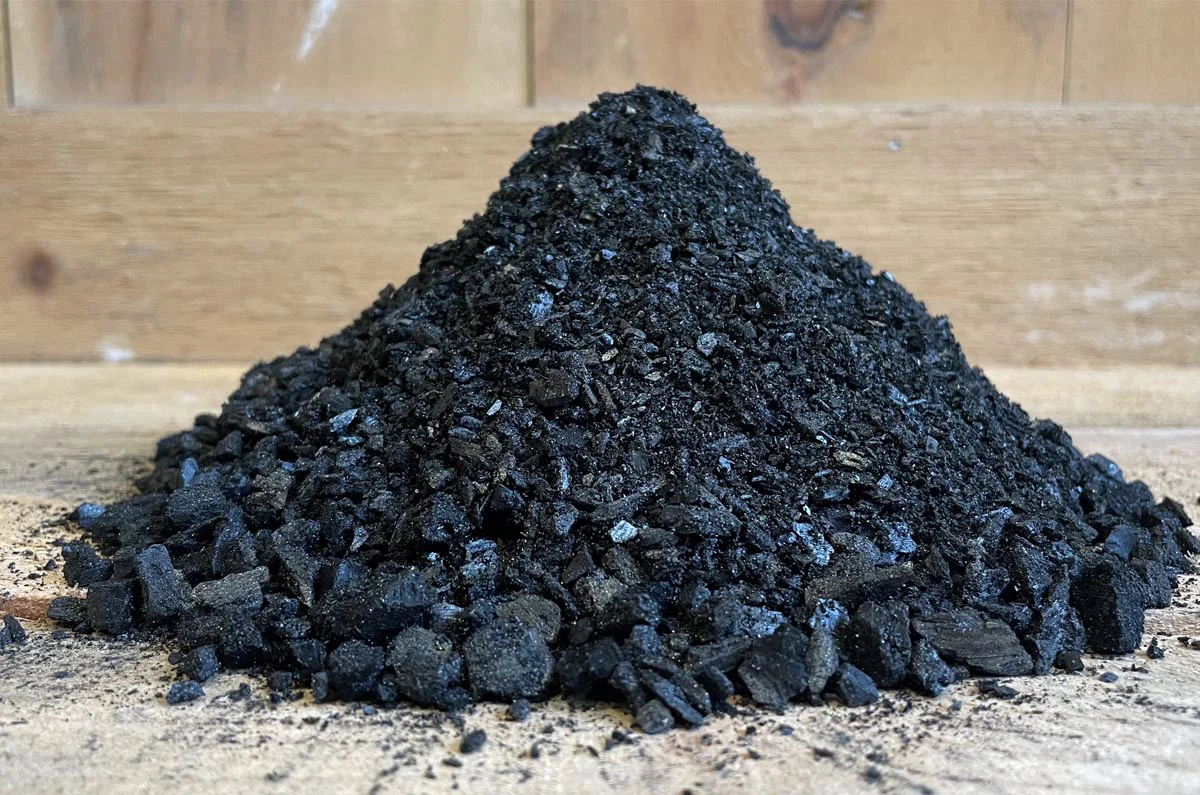
Biochar is created through pyrolysis — a high-temperature process that heats organic material in a low-oxygen environment. Instead of fully burning biomass and releasing most of its carbon back into the atmosphere, pyrolysis converts a portion of that material into a stable form of carbon that can remain in soils for hundreds or even thousands of years.
In other words, what is typically treated as forest waste can become part of a carbon removal strategy.
Reimagining Forest Waste
Spadafora grounded the discussion in the history of wildfire management in the West. After the Great Fire of 1910, U.S. fire policy shifted heavily toward suppression. Over time, that approach contributed to a “fire deficit” in many forests, allowing fuels to build up unnaturally and increasing the risk of high-intensity wildfire.
Today, much of the biomass generated during thinning and fuels reduction projects is still handled as a waste product. It is chipped, hauled away, spread across the landscape, or piled and burned. While pile burning is simple and common, it also releases smoke, particulate pollution, and greenhouse gases — and it misses an ecological function that fire historically provided.
“Fire,although it is a destructive force, is also an essential ecosystem service,” Spadafora noted.
One of those lost functions is the creation of long-lasting carbon in the soil. In natural fire regimes, some carbon remains behind in charred material and contributes to soil health and forest recovery. Biochar production offers a way to restore that benefit while still carrying out necessary fuels reduction work.
A Cleaner Alternative to Pile Burning
The webinar highlighted flame cap kilns as a practical, lower-tech method for producing biochar in the field.
These kilns are relatively simple vessels that are filled with biomass and lit from the top. That top flame creates a “flame cap” that helps limit oxygen lower in the pile, allowing the biomass underneath to cook rather than fully combust. Once the kiln is full or the available material has been processed, the remaining hot material is quenched with water, locking the carbon into stable biochar.
Compared with conventional pile burning, presenters said flame cap kilns can significantly reduce harmful emissions. Vanderkloot noted that kiln systems can reduce fine particulate pollution by more than 70 percent, carbon monoxide and nitrogen oxide by more than 90 percent, and methane by over 40 percent compared with pile burning.
That means less smoke in nearby communities, lower public health impacts, and more of the carbon retained in a useful form rather than lost to the atmosphere.
For communities that regularly deal with smoke from fuels reduction work — or the anxiety of visible pile burns near neighborhoods — that is a meaningful operational and public-facing benefit.
From Waste to Climate Asset
Beyond reducing smoke and wildfire risk, biochar can improve soils by increasing water-holding capacity, nutrient retention, and soil structure. When spread back onto treated forest areas, it can help return some of the ecological benefits that fire once provided naturally.
But the panelists made clear that the real opportunity is not just ecological. It is also financial.
Vanderkloot explained that voluntary carbon markets are creating growing demand for durable carbon removal. In the case of biochar, trees absorb carbon as they grow. If that biomass is simply burned, the carbon is released. If some of it is converted into stable biochar, a portion of that carbon remains stored for centuries — creating measurable climate value.
That value can potentially be monetized.
Using one larger kiln as an example, Vanderkloot estimated that a single day of operation could process 10 to 20 tons of biomass, produce about two tons of biochar, and result in roughly five tons of net carbon dioxide removal. At a carbon price of $200 per ton, that could translate to around $1,000 in gross revenue per day once credits are verified and sold.
For communities already doing fuels reduction work, that opens up the possibility of turning a disposal cost into a source of funding.
The Access Problem — and a Coalition Model
Still, accessing carbon markets is not easy for small towns, local operators, or community-scale forestry crews.
To generate carbon credit revenue, projects must document feedstocks, track operating conditions, quantify carbon outcomes, meet registry requirements, and package credits in a way buyers can trust. Those steps are often too costly or administratively burdensome for smaller projects to manage on their own.
That challenge is what the Riseline Foundation is trying to solve.
Vanderkloot described Riseline as a nonprofit coalition builder focused on helping rural and mountain communities participate in carbon markets through aggregated biochar projects. Rather than asking each town or operator to develop its own market pathway, the coalition model brings multiple community-scale projects together into one portfolio.
Riseline then helps manage the back-end work: carbon accounting, documentation, lab coordination, registry requirements, and connections to buyers. The goal is to allow communities to keep the economic and environmental benefits local while removing the barriers that usually keep small projects out of the market.
The coalition approach also helps create scale and consistency — something buyers often require but individual communities may struggle to provide on their own.
Practical Questions Still Matter
The Q&A portion of the webinar underscored that while biochar is promising, implementation still depends on practical realities.
Panelists discussed permitting, steep slopes, transporting biomass, material size, and the tradeoffs between portable kilns and larger systems. In many cases, there is no single best answer. Some sites are well suited to kiln-based biochar production, while others may still rely partly on conventional pile burning because of access or terrain constraints.
Spadafora emphasized that even partial adoption can matter. If communities can redirect even a portion of material away from pile burning and into biochar production, that can reduce smoke, lower emissions, and restore some ecological function.
The presenters also stressed that this is not about one perfect technology. Different kilns, project sizes, and operating models may make sense in different places. What matters is building tools and systems that help communities choose approaches that are feasible, safe, and beneficial at the local level.
A Deployable Climate Solution for Mountain Communities
One of the strongest themes of the webinar was that biochar is not a distant or overly theoretical climate idea. It is a deployable solution that can fit into work many communities are already doing.
Fuel reduction crews already generate slash. Transfer stations already handle woody waste. Fire-prone communities already spend money trying to reduce risk. Biochar offers a way to connect that existing work to longer-term resilience, carbon removal, and potentially new revenue streams.
As mountain communities search for scalable, cost-effective ways to live with wildfire and climate change, biochar may offer a rare combination of benefits: reduced fuels, lower smoke, healthier soils, durable carbon storage, and new pathways for project finance.
The challenge now is moving from isolated examples to broader implementation.
For communities interested in getting started, the panelists encouraged reaching out early, assessing available biomass streams, exploring partnerships, and considering whether biochar could become part of a local wildfire resilience strategy.
The need is urgent. But as this conversation made clear, so is the opportunity.
- Hilary Lewkowitz, Director of Destination Development & Sustainability, Colorado Tourism Office
- Eliza Voss, Vice President of Marketing, Aspen Chamber Resort Association
- Sarah-Jane Johnson, Tourism & Destination Services Manager, City of Durango
This webinar will spotlight an innovative, action-oriented model designed to equip mountain communities to lead the way on climate response through strategic collaboration with tourism partners.